There's a version of process transformation that every director in a mid-sized company recognizes and dreads. A top-tier firm arrives. A team of analysts runs six weeks of interviews. A deck appears. It contains real insight, often excellent insight, plus a price tag that makes the board wince. Then, more often than anyone wants to admit, the deck goes into a drawer. The recommendations are too sweeping, the implementation path too vague, the internal team too stretched to execute. The problem that started the engagement is still the problem a year later.
We think the methods are right. The economics and the delivery model are what's broken.
Process Transformation at Partners uses the same techniques the best consulting firms in the world use: value stream mapping, process mining, and the discipline of looking at a business as a system of flows rather than a collection of departments. What's different is how fast we work, what we charge for it, and what you actually have in your hands at the end.
What's broken about the traditional model
Big-firm process work is structured around a specific economic assumption: that the client will pay a lot, wait a long time, and absorb a massive document at the end. That assumption shaped everything about how those engagements run. Long discovery phases. Large teams. Recommendations written at a level of abstraction that protects the firm from being held to implementation.
Most leaders we talk to don't need a three-hundred-page diagnosis. They need to know the three things that are costing them the most right now and what to do about each of them, in enough detail that the work can actually start next week.
That's the gap we built our process offering around.
The methods are real
We want to be clear about this, because the phrase "process transformation" has been diluted by years of people using it to mean "we'll look at your org chart and suggest some meetings."
Value stream mapping is a structured way of tracing how value moves through a business, from the customer's request to the moment the customer is satisfied. It then identifies every step along the way that adds time, cost, or friction without adding value. Process mining is the practice of using the digital traces your systems already produce to reconstruct what's actually happening in a process, rather than what the process documentation claims is happening. These methods are not theoretical. They are how serious transformation work gets done at the largest companies in the world, and they produce insight that interview-based consulting almost never reaches.
One of our founders spent years leading a roughly one-hundred-person transformation team at AT&T, responsible for finding and delivering these kinds of improvements across one of the biggest companies on the planet. The methods we use at Partners aren't borrowed from a textbook. They're the ones that worked at that scale, adapted for the pace and budget a mid-sized company actually operates on.
What a process sprint produces
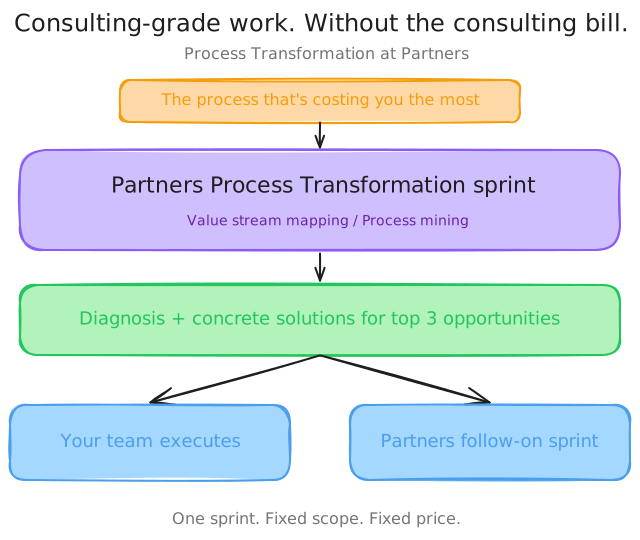
A Process Transformation sprint at Partners delivers two things.
A diagnosis. A clear, evidence-based picture of where time, money, and friction are being lost in the process we examined. Not an opinion. Not a slide of bullet points. A mapped view of how the work actually flows today, grounded in the data your systems are already producing.
Concrete solutions for the top three opportunities. We don't hand you a list of thirty-seven things that could theoretically be improved. We identify the three opportunities with the highest ratio of value to effort, and for each one we describe, specifically, what to change, how to change it, and what the result should look like. The kind of detail a leader can take to a team on Monday morning and start executing against.
One sprint. Fixed price. Working output.
What usually happens next
In most engagements, the diagnosis is the beginning of the interesting conversation, not the end of it. Once the top three opportunities are on the table, the question becomes implementation. This is where Partners differs from a pure consulting firm.
We don't just recommend. We can build. If the solution to one of the three opportunities is a custom application, a data pipeline, an ERP extension, or an automated workflow, that work happens inside Partners in follow-on sprints. The same people diagnose and build. Same AI-native engineering. Same fixed-scope, fixed-price discipline. If the solution is organizational rather than technical, the diagnosis is documented in enough detail that your internal team can execute it without us.
Either way, you own the output. Full documentation. No lock-in. No ongoing dependency you didn't choose.